210D ripstop
Running vests and kids packs. Lower mass, more care on abrasion. Bartacks at hose clips are still required; denier is not a substitute for stitch pattern.
Camelbak technology is the stack behind a hydration backpack: TPU reservoir film versus cheaper PE, bite-valve shutoff, hose length, ventilated back-panel geometry, 210D versus 420D ripstop, and rain films that are either DWR plus PU coating or a laminated membrane with hydrostatic head named in millimetres.
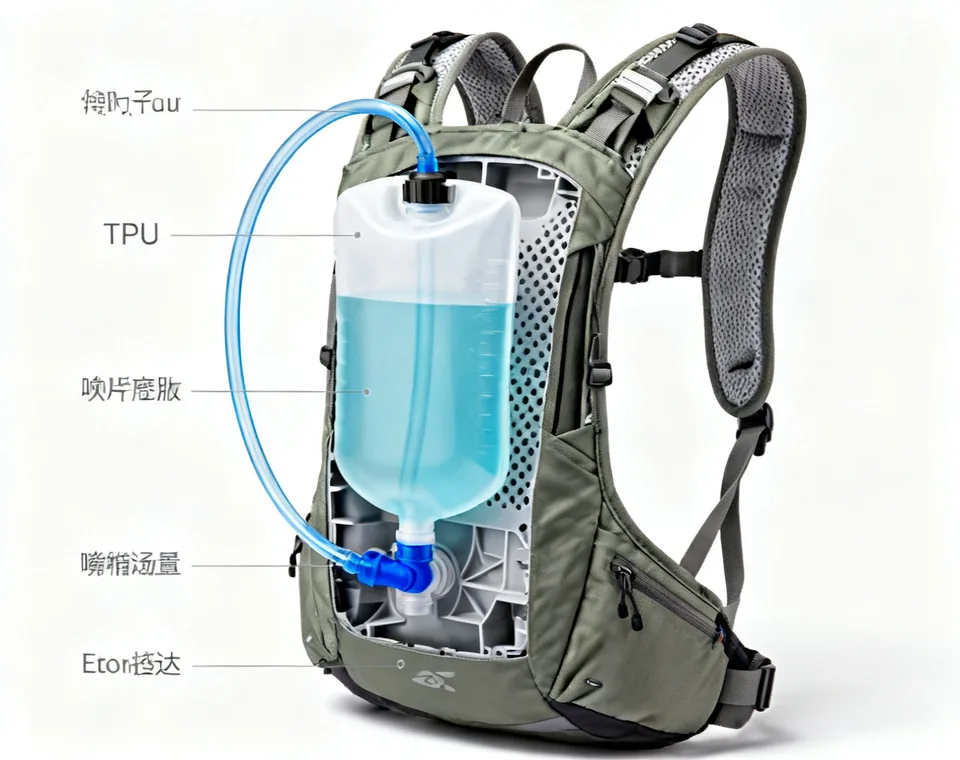

PE bladders are lighter on a spreadsheet and harder to dry after a weekend in a trunk. TPU film flexes at the weld, takes a wide-mouth fill and can be inverted on a hanging tab. Camelbak specifies TPU for 1.5 L, 2 L and 3 L reservoirs because leak-flex cycling is part of the sample gate, not an optional extra for “premium” colorways.
Bite valves include a shutoff so a packed duffel does not weep. Hose length is a centimetre call, not a lifestyle accessory: running vests use a short path to the sternum; hiking packs need extra length once the hip belt is cinched. Magnetic sternum clips are tested for glove use on bike programs.
We do not claim a reservoir is BPA-free unless the film grade is on the BOM. We do not claim the shell is food-contact certified because the nylon pack is not the drinking surface. Those two sentences exist because buyers still mix them.
Request a reservoir specThe industry still argues laminated waterproof membranes against DWR plus PU coating. Camelbak treats that as a BOM choice, not a morality play. A DWR+PU daypack can shed a shower and still wet out on a long alpine traverse. A laminated film raises hydrostatic head and stiffness. If the brief needs a dry pocket, we name millimetres. If it only needs DWR, we refuse the phrase “100% waterproof.”
Running vests and kids packs. Lower mass, more care on abrasion. Bartacks at hose clips are still required; denier is not a substitute for stitch pattern.
Hiking and duty chassis. Heavier yarn, better scrape resistance on granite. Zipper tape and seam allowance change, which is why a denier swap restarts sampling.
Mesh channels stand off the foam so air can move. A flat EVA pad with a printed “airflow” graphic is not the same geometry and is not quoted as a ventilated panel.
Shoulder rails and hip-belt angle are graded. Load should move to the hips on 3 L hiking packs. Race vests keep load on the chest and accept that tradeoff in writing.
OEKO-TEX STANDARD 100 is cited on named textile components. bluesign-approved mill inputs are cited only with mill scope. ISO 9001:2015 is the quality system, not a fabric certificate. Abrasion, UV and zipper-cycle methods are listed on the sample report when the buyer asks; we do not invent a “2× more durable” headline without the method and the lab.
Stock-wholesale freezes this stack. Private-label OEM may change color and marks but not the reservoir film or torso-length grade without a new sample. That dispute — catalog speed versus a rewritten chassis — is the usual reason a five-day OEM proposal is longer than a one-day stock quote.
Limits we will put in the quote: DWR plus PU coating is not a dry-bag; laminated films add stiffness and may change zipper tape; PE reservoirs are not offered as a silent substitute for TPU; a one-size foam pad is not a torso-length harness; kids 1.5 L packs do not inherit 3 L duty copy. Leak-flex, inverted fill and loaded torso-board checks are the sample methods; they are not a published third-party round-robin dataset.
Ask for reservoir film, denier, rain-film type, hydrostatic head and torso-length grades on the same sheet. Customize only after those fields are frozen.