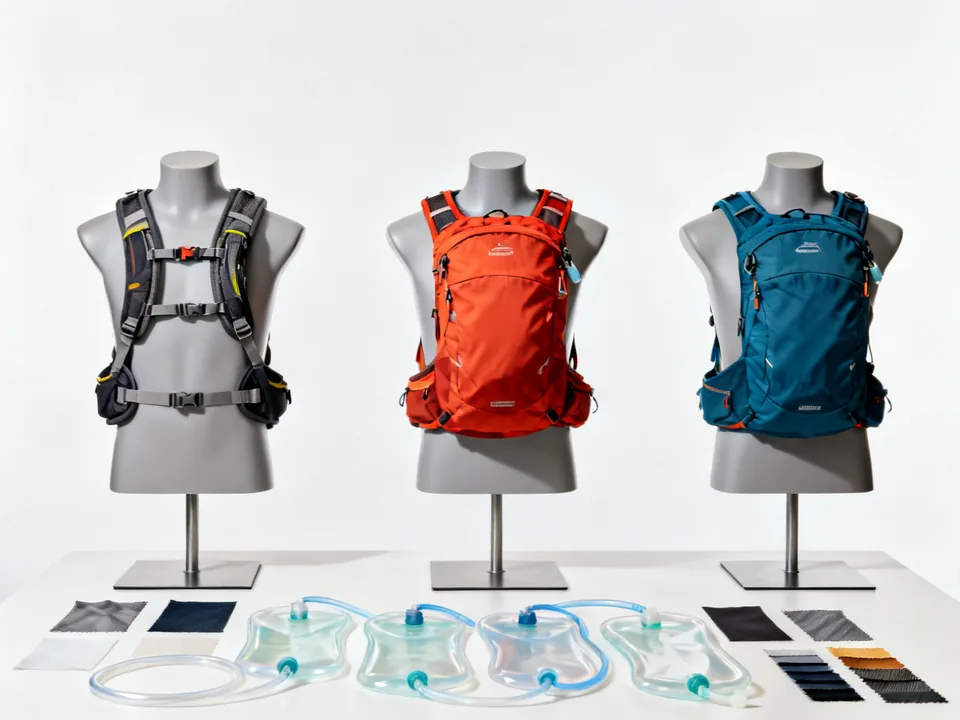

Camelbak pattern and sample room with hydration packs on a torso board
Construction story

Inside Camelbak — How We Engineer Reservoir Carry

Camelbak treats a hydration backpack as a small plumbing problem attached to a textile chassis. The reservoir must fill, seal, flex and dry. The harness must keep that mass on the torso without turning the lumbar foam into a heat sink. The shell must survive abrasion at a named denier. That is the company story we still tell buyers.

From a hands-free drink idea to a specified pack system

Hands-free hydration started in 1988 as a practical answer to drinking on the move without dropping a bottle. Camelbak still organizes the catalog around that job: keep water on the back, keep the bite valve at the collar, keep the hose from whipping the shoulder. The difference now is that wholesale and OEM buyers require the job to be written as litres, denier, hydrostatic head and torso length, not as a founding myth.

If the reservoir volume, hose path and torso-length grade cannot be read from the spec sheet, the pack is not ready for a channel PO.

Pattern rooms grade running vests separately from hiking chassis. A 1.5 L vest uses a low-profile bladder and a short hose. A 3 L hiking pack adds a hip belt and a longer hose so the bite valve still reaches the collar when the hip belt is cinched. Duty colorways mute hardware; kids colorways stay character-free unless licensed art and CPSIA files arrive with the brief. A vest copied onto hiking foam will hot-spot at tempo; that trade-off is why the two BOMs stay separate after 1988-era hands-free routing met modern torso-length grading.

We do not claim a factory-wide bluesign or OEKO-TEX blanket. Textile scope is named per mill and per component. ISO 9001:2015 describes the quality system. amfori BSCI describes social audit scope. Those documents are attached to programs, not used as wallpaper behind a lifestyle hero.

Repairability is part of the same story. Ladder locks, sternum magnets and bite valves are specified as service parts. A failed slider should not force a retailer to landfill a pack whose TPU bladder still holds. That is a construction choice, not a circular-economy slogan.

Values that show up on a Camelbak spec sheet

Measure the bladder

Volume in litres, film type, shutoff, fill port. If it is not measured, it is not a reservoir SKU.

Grade the torso

Harness geometry is a fit system. Foam thickness without torso length is padding, not carry tech.

Name the fabric stack

210D or 420D ripstop, DWR+PU or laminated film, hydrostatic head when a rain cover is in the BOM.

Keep youth distinct

Kids packs carry CPSIA notes and a smaller reservoir. They do not inherit duty or adult military copy.

Youth running group using Camelbak kids hydration packs

Youth sport programs need a smaller, documented pack

Club and school buyers ask for a reservoir a young runner can fill at a fountain, a hose they can bite without adult hand strength, and paperwork that names CPSIA. Camelbak keeps that program on its own BOM so adult 3 L hiking language never lands on a kids hangtag.

We also refuse character-licensed shells unless the buyer owns the license. A school backpack with a mascot print is a different product category than an outdoor hydration pack, and it is not how this catalog is built.

Trail association volunteers filling Camelbak reservoirs at a water station

Trail events care about fill speed and leak-free shutoff

Aid-station crews care whether a wide-mouth TPU bladder can be filled in seconds and whether the bite valve stays shut in a crate of packs. Camelbak documents those two checks because they decide whether a race director restocks the same SKU next season.

We do not publish named athlete endorsements here. Channel evidence is written as buyer roles and inspection checks, which is what a wholesale desk can actually verify.

Talk with the Camelbak construction desk

If you need the reservoir, harness and denier written into a program brief, send company, country, product type and channel.

Enter a contact name.
Enter a valid email.
Company name is required.
Country is required.
Select a product type.
Select a channel.
Add enough specification context to route the request.

Stock items: quote within 1 business day. Custom / OEM projects: full proposal within 5 business days. Compliance documentation requests: dossier within 3 business days.